
Press Release for Future of TV Event
PRESS RELEASE
FOR IMMEDIATE RELEASE
9th October 2026
Here is the press release that was issued by the Media Society after its Zoom event ‘The Future of TV in the UK’.
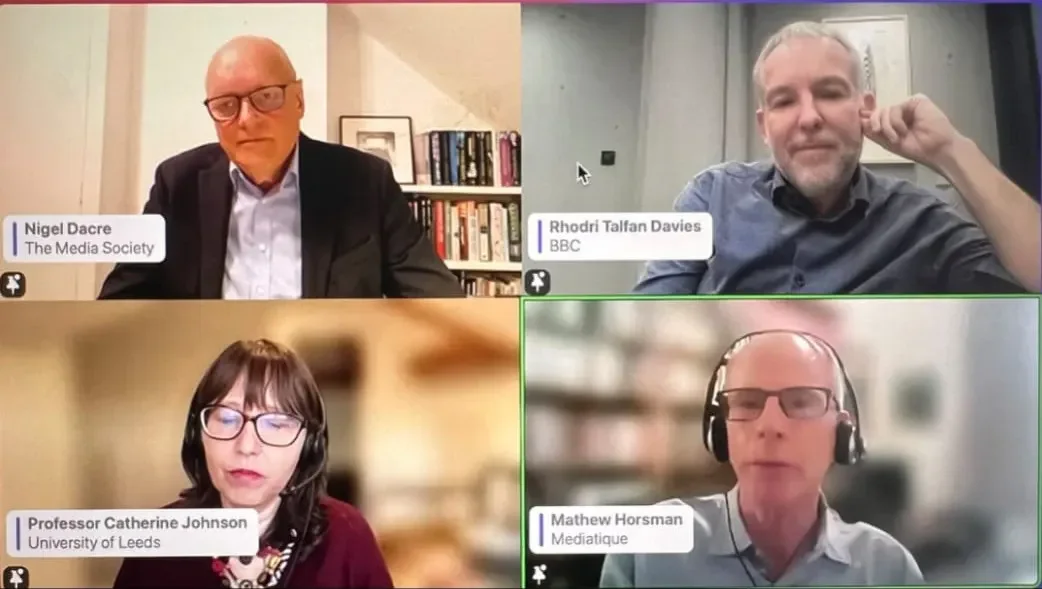
The panel: Nigel Dacre (top left), Rhodri Talfan Davies (top right), Prof Catherine Johnson (bottom left) and Mathew Horsman (bottom right).
Deputy Director-General of the BBC, Rhodri Talfan Davies, warns a "simple rollover" of BBC funding would be "profoundly damaging". But he said he was "doubtful" a household levy would replace the licence fee.
Licence Fee
The BBC's Deputy Director-General, Rhodri Talfan Davies, has said he is "doubtful" that a household levy will replace the licence fee. He warned that keeping the current funding model unchanged would be "profoundly damaging" to the corporation.
He was speaking at a Media Society discussion, Tectonic Changes in TV: What's Next for British Television, held via Zoom on Wednesday 7 October. The event was chaired by Media Society President Nigel Dacre.
Asked about the future of the licence fee, Mr Talfan Davies said the BBC expected the government's white paper by Christmas. He argued that the current funding model was neither sustainable nor fair:
“We're still anticipating a white paper by Christmas. I think there are various models in play. I mean, clearly a lot of those who gave evidence to the Culture and Media Committee talked about the role of a potential household levy, which is the model that Germany has adopted in recent years.
“I think the politics of that is pretty difficult, but I do think people have understood that if you have a broadcast institution that still commands about 94-95% of people coming into us every month, but you have a funding base where only 80% of people pay, you need to look at that funding model because that's not sustainable, neither is it fair.
“There are other models beyond a household levy. You could look at a reform or an extension of the scope of the existing TV licence fee. But I think what is understood, and I would say this is understood within government too, is that a simple rollover of the existing funding structure is going to be profoundly damaging to the BBC.
“If you want the BBC to be of scale and scope and ambition, we are going to have to find a reform, a funding reform, and I think the government understands that.”
Later in the event, Mr Talfan Davies said he did not expect the household levy to go ahead:
"I'm doubtful there'll be a household levy. I think the government has signalled that the politics of that are pretty challenging… There's been a lot of advocacy for it and there's a lot of logic to it, but I think it's probably politically too difficult."
He said the current charter review was a turning point for the corporation:
"I think the argument has landed that this is a defining charter moment. There have been previous charters where there's been a lot of debate but very little action. I think inaction in this charter process will condemn the BBC to manage decline for the next period, and will diminish the organisation in pretty much every sense."
Rebuilding trust
Mr Talfan Davies was asked how the BBC would rebuild trust after the events of last year. He said the corporation's slow response had done more harm than the errors themselves:
"Last year was incredibly difficult. It was damaging to the brand and our relationship with audiences, but we remain in a strong place. We are the most respected and trusted news brand, not just in the United Kingdom but across the globe.
“Clearly, we operate in a polarised world where it is harder to hold all communities together in terms of their trust in institutions, but we are still in an unrivalled position. You know, in the UK we are streets ahead of any other news provider in terms of national trust.
“But we have to learn some hard lessons from last year. Yes, there were some on-air issues, but I suspect our sluggishness in our response caused more difficulties for us than the actual errors. One of my jobs coming into this role is to make sure that we are much more robust and fast in how we respond to these challenges."
Cuts to programmes, channels and jobs
Mr Talfan Davies said the BBC is reducing 2,000 roles over the next 18 months as it makes £500 million of savings. He told the audience that some “much-loved” radio programmes will be lost:
"There are clearly some titles that are going to disappear, and they're much-loved titles, and that's tough stuff. But what I would say is look across the breadth of Radio 4, look across the breadth of Radio 3. These are still incredibly distinctive, rich services.
“Taking £500 million out of the system in 18 months is a tough task, but we will do it with care, and with an understanding that Radio 4 and Radio 3 play a critical, central role in our cultural life…
“But it's difficult. There are some decisions which you look at and you go like, this is hard. But if you're taking out that level of funding, there are going to be tough calls.”
He also confirmed that the BBC's portfolio of TV channels would shrink as viewing moves online:
"It's no secret that we're reviewing the breadth of our broadcast channels… There is a clear direction of travel in audience consumption towards online and on-demand usage, and so we will see over time a reduction in the breadth of the television portfolio. It's really tricky for colleagues. It has to be done with real care, and you have to be profoundly careful with your relationship with audiences.
"There's no easy route through this, but we have a financial responsibility, and until that funding solution or reform materialises, we have a job to do which we have to get on with.”
"A very significant cultural transfer of power"
Mr Talfan Davies also warned of the growing dominance of US platforms over British audiences:
"80% of consumption on YouTube by UK audiences is to US content. We are seeing a very significant cultural transfer of power. We have traditionally seen public service broadcasting in the UK as an incredible strength, but what we are seeing is fragility, and we are going to have to act with more intent if we want to protect that space."
Mr Talfan Davies was joined on the panel by Professor Catherine Johnson, Professor of Media and Communication at the University of Leeds, and by media analyst Mathew Horsman, founder of Mediatique. The discussion also covered Sky's proposed acquisition of ITV, the future of linear TV, prominence for public service broadcasters, and when the digital terrestrial TV network should be switched off.